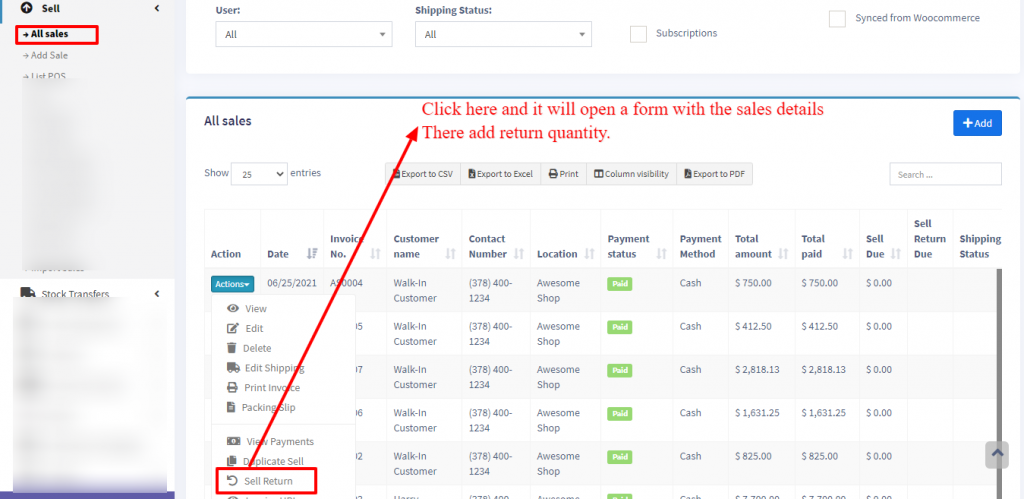
Status should be Complete for the transaction to complete
Once the status is marked completed stock transfer cannot be edited. But can be deleted
Stock transfer can be only be edited when the status of the transfer is pending or in transit.
After it is completed, the stock transfer cannot be edited. Although you can delete it and create a fresh one if you would like to.
Sales Order is a document given by the supplier to the buyer against a Purchase Order by the buyer.
A sales order contains the buyer invoicing details, delivery details, products, quantities, pricing, tax, discounts, payment terms, payment details, shipping charges if any, and other notes.
Once the buyer agrees on the sales order, goods are shipped by the supplier.
Sale order has multiple statuses: Ordered, Partial, Completed
To enable Sales Order, follow the below steps:
Go to Settings -> Business Settings
Sales tab -> Enable Sales Order
Save it.
After Enabling sales order, inside Sales you’ll find the Sales-Order menu.
Go to add sales order, fill in all the details and save it.
Stocks are not deducted for sales orders.
Once a sales order is created you can print it and send it to the buyer for approval.
On approval of sales orders, you can create sales from the sales order.
Go to Sales -> Add sales, select the business location & Customer.
On Selecting it will populate the list of all sales orders related to the customer on the “Sales Order” dropdown.
Select the Sales Order and it will auto load the products for that order with the product’s price, tax, discounts applied automatically as the sales order.
You can increase or decrease the quantity.
This is useful if you want to create a quotation before sales.
Marking a sales as Draft or Quotations will not deduct the available stock.
You can view all Quotations & Drafts from List Quotation or List Draft respectively. Existing draft/Quotation can be edited to make it as final sales.
To convert a draft/quotation to sale invoice, follow the steps below
Go to List draft / List quotation. Click on the action button.
Select edit in the dropdown.
Change the status from draft/Quotation to Final and save it.
Quotations can be copied or duplicated.
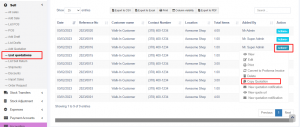
Go to Sale > List Quotations > Actions > Copy Quotation
Suspend Sales means unfinished sale or hold Sale.
Suspended
sales stock gets deducted from available stock. You can view all
suspended sales by clicking on the Yellow Color button present in
very top right of screen (above the date).
In a grocery store, if you have suspended button, you can suspend particular customers sales and entertain another customer, when his comeback you can proceed with his sale.
In Restaurant, you can suspend the order of customers if not yet paid, and finish it when they finish eating and paid their order, so you can proceed to final sales. You can put Table 1, Table 2, Table 3… so when they finish it’s easy to identify table 3 going to pay.
In hotel lots of customers check in stay for 2 nights and order some foods and customers say, just charge to room 024. So you can suspend their orders and edit if there is some additional order and suspend again. Until final it when they pay their bills. on Hotel, on Reference Number: Room 009, Room 012
Multiple Pay: Used when the customer wants to pay with different payment methods like some amount by card, some by cash and some other payment methods. This option is also used when the customer doesn’t pay the exact tender amount and you need to calculate the Return Change.
Card: Used when the customer wants to pay the complete invoice by card.
Cash: Used when customer pay the exact amount of invoice by cash. If the customer pays less or more amount then the invoice amount then use Multiple Pay to get change return.
Go to contact -> Suppliers. Click on actions for the supplier and it will show “Pay Due amount”, click on it and pay the amount. “Pay Due amount” this option is not displayed if there is no payment due.
Follow
Rounding helps to round the total payable to nearest currency exchange available.
To enable rounding go to Settings -> Business Settings -> Sales and choose the Amount rounding method
Amount rounding method
Round to nearest whole number: It will round the paybale value to nearest whole number. For example 1.49 will be rounded to 1.00, and 1.51will be rounded to 2.00
Round to nearest decimal (multiple of 0.05): It will round
the paybale value to nearest decimal number which is multiple of
0.05. For example 1.49 will be rounded to 1.50, 1.51 will be rounded
to 1.50, 1.59 will be rounded to 1.60, 1.54 will be rounded to
1.55
Similary all other round to nearest decimal number works
as per the multiplier.
Edit existing invoice for the sales by going to edit the invoice and remove the product or reduce the quantity of the product. And save it. The system will automatically add the returned quantity back to stock. This is a simple & recommended way of doing.
Follow the screenshot below:
Nexa ERP will adjust these values in the Profit & Loss report.
Regarding payment, users have to add a transaction for receiving payment from the customer and then paying them back. This way all the transactions are recorded.
To enable subscription, go to Modules -> Check the “Enable Subscriptions” and save it.
IMPORTANT: For subscription invoice to auto-generate cron job must be set up.
Subscriptions can be added from both POS sales or normal Sales screen.
In POS or sales screen to add a
subscriptions click on “Subscribe?” Checkbox
On clicking subscribe it shows a
popup modal, enter the subscription frequency like every 1 day
or every 5 days or every 1 month etc. Also enter the subscription
frequency, like if a user wants so subscribe only 5 times the enter
5, for unlimited leave it blank.
All subscriptions appear in Sell -> Subscriptions screen. From here you can also start/stop a subscription.
When a subscription invoice is auto-generated then a notification is sent to admin & sales person.
While adding subscription sales, the sales will be marked with an indication in the “All Sales” screen.
This indicator will be in either of two colors, blue or red.
The indicators represent
1. The blue color indicates that this is an automatically created subscription invoice.
2. The red color indicates that it is a recurring invoice that repeats for a specified number of times and turns to the blue color invoice when the number of times specified is reached.
Invoice Layout helps you to create different invoice formats.
To add a new invoice layout:
Go to Settings->Invoice Settings->Invoice Layout->Add
Give a unique distinguishable Layout name
Add the text to be shown in the top/header of invoice. Generally, it can be your shop name, aligned center with Heading 1 format.
Add other relevant details.
You can show/hide address fields.
You can mark a layout as default. The default layout is used when no layout is found for a location.
Click on Save.
To use an invoice layout in a location go to” Business Locations -> Edit” and assign the invoice layout.
In invoice layout, you will find options for invoice designs.
Used for browser-based printing only & NOT print server-based
printing.
To manually change the code for invoice layout the path
is: resources/views/sale_pos/receipts/{design_name}.blade.php
Where
design_name = name of the design you want to change like
classic/elegant/detailed/slim etc.
To see the tax summary in invoice, go to add/edit invoice layout, and enter the “Tax Summary Label” option and it will show the tax summary in invoice.
To display total in words in the invoice Enable:
Choose “Word Format”
To display the discounted unit price and discount amount in the invoice, enable the following filed in invoice layout
Discounted unit price label
Discount label
To display the reduction summary of quantity from multiple units, enable the check box ‘show base unit details (If applicable)’.
The sale custom fields can be added to the printed invoice.
Step
1: To achieve it, Go to Settings >
Invoice Settings > Invoice Layout.
Step
2: Select the invoice layout in which you need the sale
custom fields to be printed.
Step 3: Enable
the checkboxes for the sell custom fields, “sell 1”, “sell2”
etc, and save it.
Now, when you use this chosen invoice layout, the custom fields you set up for sales will automatically appear on the printed invoice.
A letterhead image containing all details of your business(organization name, address, business registration & other details) can be added to invoices.
Letterhead will be displayed at the top portion of the invoices.
Go to Settings > Invoice Settings > Invoice Layout.
Enable the “show letterhead” checkbox.
Upload the letterhead file (Max 1 MB)
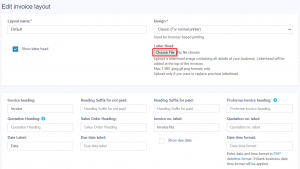
Edit an invoice layout
Scroll down to the QR code section at the bottom
Click Show QR Code
Enable all the fields required in QR code, like Business Name, Business Name, Invoice URL, and others
Save the invoice layout. Print an invoice and you’ll see the QR code in the invoice
Show Labels: Enable this option to show the labels(key-value pair) in QR code
ZATCA (Fatoora) QR code: This is mostly required in Saudi Arabia country. Enabling this will generate a QR code in LTV-base64 format.
Invoice External Link

Choose- Invoice Url and copy the Link
With invoice external URL you can share the invoice to a customer via a link.
With this link, they can see & print the invoice without they having to login into the system.
The link can also be sent in Email & SMS notification. To send url in Email/SMS notification add it in notification template using the url tag.
Name: Enter a meaning full name for the discount.
Brand: Select the product brand where it will be applied.
Category: Select the produc Category where it will be applied.
Location: Select the location
Priority: Discount
with higher priority will have higher weight, however priority will
not be considered for exact matches.
For example: if there are
2 discounts available for the same brand and/or category then the
disount with higher priority will be applied.
Discount type: Fixed or Percentage
Start At: Start date of the discount.
End At: Start date of the discount.
Apply in selling price groups: If checked then the discount will be applied in the selling price group price. If not then it will not be applied.
Apply in customer groups: If checked then the discount will be applied in the customer group price. If not then it will not be applied.
Is active: Activate or not.

Go to Settings -> Business Settings -> Reward Points Settings.
Click on Enable Reward Point and it will get enabled.
Reward points settings is divided into 2 parts:
Earning Points Settings
Redeem points settings
Reward points display name: This is display or label name for reward points. Some people like to keep it as reward points or reward coins etc. Only used for displaying label.
Amount spent for unit
point: Meaning how much the customer spent to get one
reward points.
Example
If you set it as
10, then for every $10 spent by customer they will get one reward
points.
If the customer purchases for $1000 then they will get
100 reward points.
Minimum order total to
earn a reward: The minimum amount the customer should
spend to get reward points.
Example:
If
you set it as 100 then the customer will get reward points only if
there invoice total is greater or equal to 100. If the invoice total
is 99 then they won’t get any reward points.
You can set it
as a minimum of 1.
Maximum points per order: Maximum reward points customer can earn in one invoice. Leave it empty if you don’t want any such restrictions.
Redeem amount per unit
point: It indicates the redeem amount per point.
For
example: If 1 point is $1 then enter the value as 1.
If 2 points are $1 then enter the value as 0.50.
Minimum order total to redeem point: Minimum order total for which customers can redeem points.
Minimum redeem point per order: Minimum redeem points that can be used per invoice. Leave it blank if you don’t need this restriction.
Maximum redeem point per order: Maximum points that can be used in one order. Leave it blank if you don’t need this restriction.
Redeem point expiry period: Expiry
period for points earned by customers. You can set it in months or
years. Expired points will get deducted from the customer account
automatically after this period.
NOTE: You
must set the cron job for expiry feature to work. Cron
Job Document
To display customers remaining reward point in invoice you can choose the option in invoice layout to display it.
A proforma invoice is an estimated invoice that is used to request payment from the buyer for goods or services before they are supplied.
The quotations can be converted to proforma invoices.
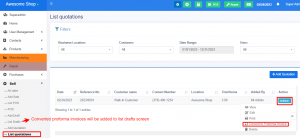
Select ‘Convert to proforma invoice’ from the action dropdown button on the list quotation page.
The proforma invoices will be added to the ‘list drafts’ screen. You can convert them later into actual invoices.
To add bulk sales to the system, you can use this feature.
Go to Sale > Import Sale.
Click the ‘Download Template’ button to download the template file.
Once downloaded, open it and add the required details. While adding the details follow the instructions mentioned on the import sale page itself.
Save the excel file and upload it by clicking the choose file button and pressing submit button.
NOTE: It may display some error after uploading if some data added in the excel file are not as per mentioned in the instructions.
Change it accordingly and proceed.
While importing an Excel file for import sale you have to select the option “Group Sell Line By“.
This field is used for the system to know which lines need to be in a single sale.
For example, if you add an Invoice_Number column in the Excel import file, then all lines from one sale will have the same Invoice_Number.
In this case, you need to select Invoice_Number option in the “Group Sell Line By” dropdown field.
You may encounter this issue while you import an Excel file using the Sale Import feature.
This issue happens when the same option name is chosen for multiple columns in the import table
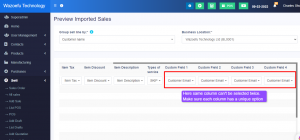
If you want to remove any column during import, you can select the SKIP option in the dropdown.
Follow the steps below to add a free item during a sale.
Add free items(that have an actual purchase price) during the sale by making the selling price 0 for those products.
Include a note in the sale description indicating that these items are free, bonus, or complementary products.
Enable the ‘sale description’ check box in the invoice layout to ensure that it is printed on the invoice (if required).